

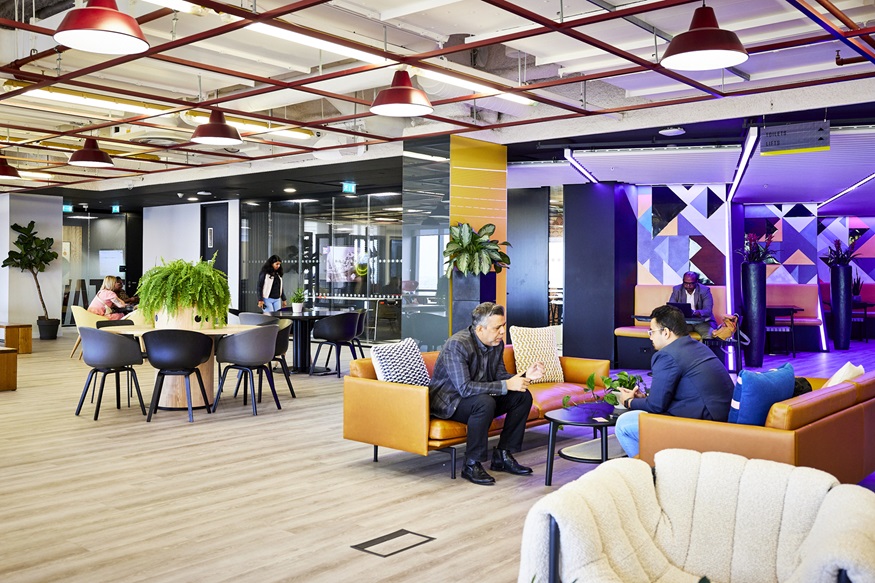

In today’s fast-paced and ever-changing work landscape, the traditional 9 to 5 office set up is giving way to a more flexible approach to work. Flexible working spaces, characterised by their adaptability and versatility, have emerged as a preferred choice for organisations seeking to accommodate diverse workstyles, promote collaboration, and enhance employee satisfaction. This piece delves into the concept of flexible working spaces, exploring their benefits, design principles and their role in shaping the future of work.
Flexible working spaces encompass a range of environments designed to support various work activities and preferences. Unlike traditional offices with fixed layouts and assigned desks, flexible spaces offer employees the freedom to choose where and how they work based on their individual needs and tasks. These spaces may include open-plan areas for collaborative work, private pods for focused tasks, communal lounges for informal meetings and quiet zones for concentration.
Benefits:
- Increased Productivity: By providing employees with options to work in environments that suit their preferences and tasks, office spaces can boost productivity. Employees have the freedom to choose the setting that best facilitates their workflow, whether it’s a quiet corner for deep focus or a collaborative area for brainstorming sessions.
- Enhanced Collaboration: Working spaces foster spontaneous interactions and collaboration among team members. By breaking down physical barriers and encouraging movement within the workspace, these environments facilitate idea sharing, knowledge exchange and teamwork.
- Improved Employee Satisfaction: Offering flexibility in where and how employees work can significantly improve job satisfaction and work-life balance. Employees appreciate the autonomy and trust granted to them, leading to higher levels of engagement, morale and retention.
- Cost efficiency: Flexible working spaces optimise space utilisation and resource allocation, allowing organisations to make more efficient use of their office space. By accommodating diverse workstyles and fluctuating team sizes, companies can reduce overhead costs associated with maintaining fixed office layouts.
Design Principles of Flexible Working Spaces:
- Modularity: Flexible working spaces should be designed with modularity in mind, allowing for easy reconfiguration to adapt to changing needs and preferences. Modular furniture, movable partitions and adaptable layouts enable flexibility and scalability within the workspace.
- Variety of settings: A successful flexible workspace offers a variety of settings to accommodate different work activities and preferences. This includes collaborative areas, quiet zones, relaxation corners and ergonomic workstations tailored to diverse user needs.
- Technology integration: Seamless integration of technology is essential for enabling flexible work practices. This includes providing ample power outlets, high-speed internet connectivity, wireless charging stations and video conferencing facilities to support remote collaboration and connectivity.
- Comfort and Well-being: Prioritising employee comfort and well-being is paramount in flexible working spaces. Ergonomic furniture, adequate lighting, good air quality and access to amenities such as refreshment areas and wellness rooms contribute to a positive and supportive work environment.
Flexible working spaces represent a paradigm shift in how we approach work and workplace design. By offering employees the autonomy to choose when, where and how they work, organisations can unlock great productivity, collaboration and employee satisfaction. As we navigate the complexities of the modern work landscape, embracing flexibility is not just a trend but a strategic imperative for organisations seeking to thrive in the years to come.
Further information regarding our full office glass partitioning systems that work well in a flexible environment can be found here: https://iwall.co.uk/glazing-systems/